Why not visit http://awards.designweek.co.uk/dw/2012/entry-showcase-13.html to see one of our recent project in the Design Week product design awards show case. Fingers crossed for a good results!

Why not visit http://awards.designweek.co.uk/dw/2012/entry-showcase-13.html to see one of our recent project in the Design Week product design awards show case. Fingers crossed for a good results!
How do you know if your new product will appeal to your customers?
We supply Product Design to a range of clients in many different situations. Not everyone understands their target customers as well as they could.
If you are fortunate enough to have regular contact with existing customers, they can be a valuable source of feedback and ideas. If every customer is crying out for something they cant currently get, it is a golden opportunity to supply something new to a ready made market.
If you are developing a new product it can be easy to make assumptions about what the end user wants, either through personal opinions or being blinkered by what the competition is doing.
A great way to understand your target market is to observe how they currently solve the problem your new product is addressing. They may be;
Armed with this kind of data the design team can propose solutions that actually solve the end users problems, not just copy the competition or refresh the current design assuming it does everything the customer needs.
The benefits of the product should then appeal to your customers and be real incentives to make a purchase. This is one of several methods utilised by our design team to understand end users and design better products.
There are many Product Design Awards over the calendar year, and most other industries will have their share of awards too. Have you ever entered one of your products in a competition?
We recently entered a new hand held electronic device into the Design Week Awards 2012.
Why? Well we don’t have particularly large egos, but is always nice if the work you do gets recognition. But the real opportunity is one of marketing. The very fact we have entered the awards gives us something positive to talk about, and suggests we are delivering high quality work worthy of consideration in a national competition. Imagine if we were to win! The product, the company who own it, and our design capabilities will receive national press for all the right reasons.
Any business can talk about their own merits, USPs, etc, but it will always carry more weight if the positive words come from an unbiased third party with industry knowledge.
When you look at your product range, do you feel it’s worthy of competing for an award against others in your sector? If not, perhaps its time for change.
The MD of a medical diagnostics business once told us he wanted his products “to be the Apple Computers of our industry”. We are certainly up for a challenge, and that particular project recently won first place in a plastics design industry competition. Great PR for the client, their product, and the design team.
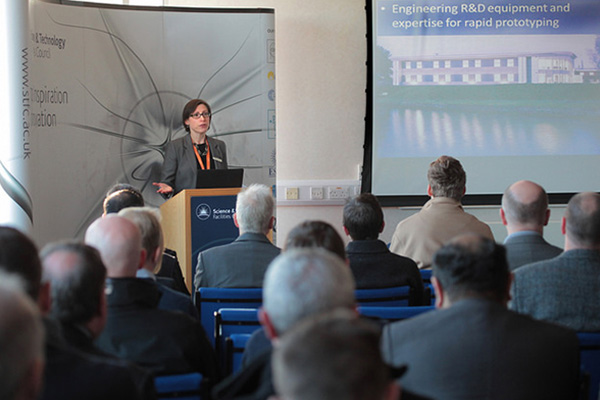
We attended a very interesting event organised by the Virtual Engineering Centre at Darsbury Science and Innovation Campus.
Cutting edge virtual engineering and simulation facilities are available to support our design team, which we can utilise on our clients projects to solve complex engineering issues at no additional cost.
4D Products where delighted to be invited into Liverpool John Moores University to talk to the Product Design course about career opportunities in design.
LJMU School of Art and Design had invited well known representatives from creative industries from the North West region including Product Design, Interior Design, and Costume Design to name just a few.
We wish the next crop of Liverpools Product Designers all the best in their future careers!
‘I don’t need to do much research’
You could go on researching forever, and at some point you need to take action to move your project forward or put a line through it and move onto the next thing. But as a minimum you should be satisfied that there is a real market need for your product. What do total strangers think? How is the problem currently solved? How many people are experiencing the problem? Is my idea better or cheaper or faster than current solutions? How would I pitch this idea as really useful to a potential user in just a few sentences?
‘I need to file a patent right away’
We would advise people to explore the best method of protecting their product idea in parallel to discussing it with a professional designer under confidentiality. If they are good they will challenge your ideas, improve on them, and bring exciting new ideas to the table which can add commercial value to the product. When you have the best solution to the problem, you can protect it in the most suitable way. Patents, design rights, registered designs, registered trade names / logos and copyright are all to be considered. If you do this without optimising the design, you risk protecting an idea that isn’t as good as it might be, and allowing competitors to easily improve on your offering.
‘I know what I want, I don’t need to pay for professional designers’
As previously mentioned, a good designer should pay for themselves many times over when the product goes to market. How so? By optimising the product, reducing its build and set-up costs, making it more attractive to the end user, and therefore securing more sales.
‘I don’t need to spend money on prototyping’
Too often people see prototyping as an expense that they would prefer to avoid. In reality it is the best opportunity you will get to learn about, and improve your product prior to costly manufacturing set up and production runs.
A good designer will present a range of prototyping options which are most suitable to you at the time. Don’t spend thousands on vacuum castings just to see how big something looks on the desk, you can find that out with a block model made from foam board.
‘My product will be great, it will sell itself!’
People have lots of choice and limited budgets. They also tend towards the familiar, buying things that have suited their purposes previously. In order to sell your new product, you need to get it in front of potential buyers and very quickly communicate why they should choose your product over someone else’s. This often comes down to clearly demonstrated benefits to a business or end user, and an acceptable price.
An e-commerce website can be great, but how are you going to drive traffic to it?
Whatever route you choose, you will need to get the marketing message right, and make the buying process as hassle and risk free as possible.
If you aren’t a seasoned sales person, should someone else be doing it? You might want to consider selling or licensing your idea to an existing business with established routes to market.
Get in touch with 4D Products if you want success in New Product Development.
Today’s consumer is much more discerning about the objects they surround themselves with. The well known consumer brands at the forefront of this movement invest heavily in product design.
These ‘consumer design’ techniques are being applied to more and more technical and industrial products for use outside of the home environment. The underlying technology works, but in an environment where virtually every buyer has choice, the product must stand out from the crowd and present itself as visually appealing, usable, and engaging.
Our clients benefit not only by creation of an attractive new design, but are also supplied with photo quality visuals of the product before it has been manufactured. A great marketing tool for generating interest and connecting with potential users and purchasers.
Get in touch if you would like your products to stand out from the crowd.
Businesses want to develop great new products in the most cost effective manner. One question that often arises is ‘How many prototypes will I need?’ Or sometimes ‘Why do we need to build a prototype? Aren’t you confident that your design will work?’
My iPhone dictionary describes a prototype as “something built for study, testing, or display”. In our design work the ‘testing’ part is key to optimising new and inventive ideas.
Wikipedia lists 5 classes of prototype;
“Proof-of-Principle Prototype - These types of models are often used to identify which design options will not work, or where further development and testing is necessary.
Form Study Prototype – Allow designers to explore the basic size, look and feel of a product without simulating the actual function.
User Experience Prototype – This type of model allows early assessment of how a potential user interacts with various elements, motions, and actions of a concept.
Visual Prototype – This will capture the intended design aesthetic and simulate the appearance, color and surface textures of the intended product.
Functional Prototype – Will attempt to simulate the final design, aesthetics, materials and functionality of the intended design.” (http://en.wikipedia.org/wiki/Prototype)
James Dyson famously made 5127 prototypes over several years before launching his game changing DC1 bagless vacuum cleaner. Now a highly successful business with Worldwide sales, the R&D engineers at Dyson are encouraged to explore new ideas by building as many proptotypes as is needed to prove or disprove a new idea. Failure is seen as a good thing, as part of the learning process of discovering new and improved solutions.
A recent article in Develop 3Ds sustainability supplement told the tale of a design consultants work for Herman Miller, developing an innovative new chair. (http://sustainability.develop3d.com/sustainability/sitting-pretty) The client had been making chairs for over 100 years, but the designers still produced over 100 prototypes during the process as part of a learning and improvement process. The designers were trying something new and innovative, and although CAD tools are very powerful, producing a real object by hand is a much more fluid and intuitive process.
We have mentioned two extreme examples, but in both cases the designers wanted to develop something new and innovative in their market. Prototyping is intrinsically linked to this process. So if someone asks ‘How many prototypes will I need?’ there is no stock answer. But a good design team will learn and improve on their ideas using a cost effective and well thought out prototyping strategy.
Our client needed a new microfluidic consumable for a hand held diagnostic device. A presentation to a potential partner in the US had been arranged in just 3 weeks time! Read the rest of this entry »
Our recent offer to fellow residents at Daresbury Innovation Centre for Product Design assistance is now fully booked. We had asked…
Why would any business spend their money on product design during a recession?
A lot of businesses are unconvinced of the the value of good design. They may view it as a bolt on activity if the budget allows. A luxury rather than a necessity.
4D Products would like the opportunity to challenge that perception and explain how product design can;
· Save you money
· Help you to stand out from the crowd
· Help you to exceed your customers expectations
· De-risk the whole product development process
· Be in a strong position when the recession ends
For one day only we are running a FREE one-to-one service at Daresbury Innovation Centre to offer confidential (under NDA), no obligation design input into your development project, at whatever stage it may be at.
Ask us a question, get an impartial opinion or advice, challenge us to demonstrate the value of design.
If you would like to benefit from access to over 20 years of product design experience, this is an opportunity not to be missed.